End-of-Year Construction Outlook: What to Know Heading into 2026
By Ben Ayers, AVP, Senior Economist, Nationwide
As 2025 closes, the construction industry continues to face headwinds from elevated costs, labor shortages and policy uncertainty. However, signs point to cautious optimism heading into 2026, driven by fiscal stimulus and potential easing of interest rates. The Nationwide Economics team recently released its Year-End 2025 Construction Industry Report, which highlights several key trends:
- Overall Industry Activity: Nonresidential construction slowed in 2025 due to high costs and interest rates – with data centers being a notable exception – but easing monetary policy and reduced uncertainty could revive activity in 2026.
- Labor Market: Labor demand softened while supply shrank due to immigration policy, and hiring is expected to remain constrained in 2026 with continued wage pressure.
- Input Costs: Tariff-related cost increases were modest in 2025 but may rise in 2026 amid trade uncertainty, though federal tax incentives could stimulate demand and domestic production.
- Building Construction: Construction spending stalled across key sectors in 2025, but federal tax incentives and long-term trends may drive a rebound in the latter half of 2026.
- Heavy & Civil Engineering: Infrastructure Act funding supported growth in 2025, but its October 2026 expiration and potential federal spending cuts pose risks to future projects.
- Specialty Trade Contractors: Labor shortages and tariffs raised costs in 2025, but fiscal stimulus and tax incentives may ease constraints and increase demand in 2026.
These trends highlight the need for construction businesses to prepare for continued cost pressures, labor constraints and policy shifts, while positioning for potential growth opportunities as federal incentives and economic conditions improve in 2026. Read on for a deeper look into these trends, or check out the full report below.
Deep Dive
Industry Trends: High costs, policy uncertainty slowed building activity, but may improve in 2026
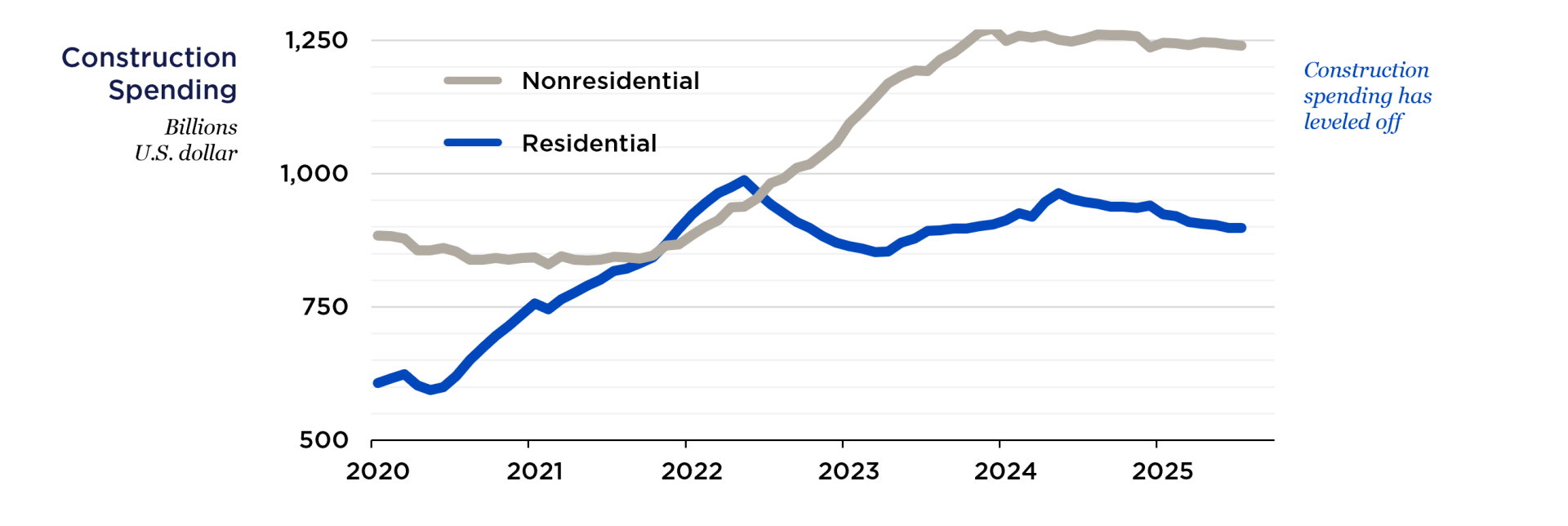
Investment in residential and nonresidential construction remained sluggish in 2025 due to elevated costs and policy uncertainty, with commercial gains largely limited to education, health care and technology – especially data centers. Construction activity outside of data centers is expected to stay soft into early 2026 as tariffs and consumer demand uncertainty continue to weigh on business investment. However, easing policy uncertainty and federal tax incentives may encourage a rebound in construction spending in the back half of 2026, though reduced government funding poses risks for public infrastructure projects.
Labor: Continued strain on construction hiring
The construction labor market rebounded strongly after the pandemic but has tightened again, with job openings falling due to slower residential and nonresidential activity. Despite easing demand, labor shortages persist, driven by a lack of experienced workers due to widespread retirements. This and impacts from tighter immigration policies continue to push wages higher within that sector. Hiring is expected to remain constrained in 2026 as firms struggle to find qualified workers, even as construction activity begins to recover later in the year.
Input Costs: Tariffs and trade uncertainty keep input costs in focus
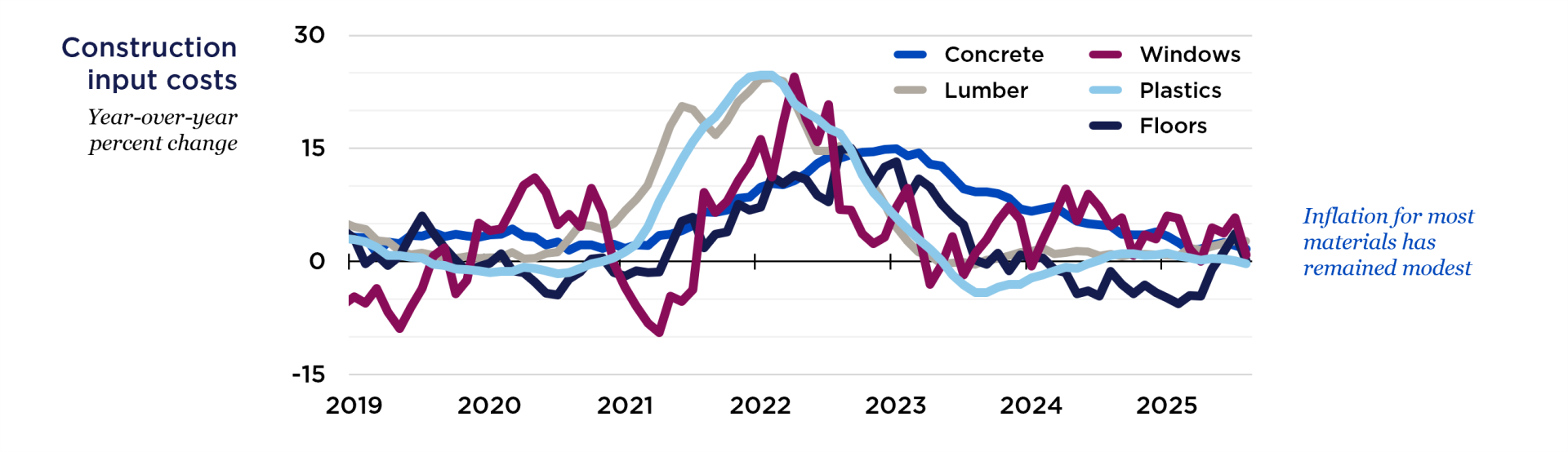
Construction material prices remain mostly stable in 2025, with tariff-related increases delayed but expected to rise as inventories deplete. Trade policy uncertainty and tariffs on key imports may continue to push input costs higher in 2026, though federal tax incentives could stimulate demand and domestic production. While these dynamics present cost-related risks, they also offer opportunities for businesses that proactively manage supply chains and financial planning.
Construction of Buildings: Signs point to a slow recovery ahead
Spending and hiring for the construction of new buildings declined in 2025 due to elevated interest rates and policy uncertainty, with manufacturing activity slowing after earlier gains from the 2022 CHIPS Act. While infrastructure construction continues to benefit from prior federal investment, commercial construction remains uneven amid tariff disruptions and mixed demand signals. Looking ahead, improved economic conditions and federal tax incentives could gradually revive building activity in 2026-2027, though reduced government spending may limit infrastructure investment.
Heavy & Civil Engineering: Infrastructure momentum faces uncertain future
Federal infrastructure funding drove strong growth in highways/streets and water/sewage systems, expanding heavy and civil engineering activity despite high labor costs and barriers to entry. While spending is expected to continue into 2026, the Infrastructure and Jobs Act of 2021 is scheduled to expire in October and broader efforts to reduce government spending could slow future project flow. This creates uncertainty for firms relying on public contracts, reinforcing the need for strategic planning and risk mitigation.
Specialty Trade Contractors: Trade contractors face headwinds, but relief may be ahead
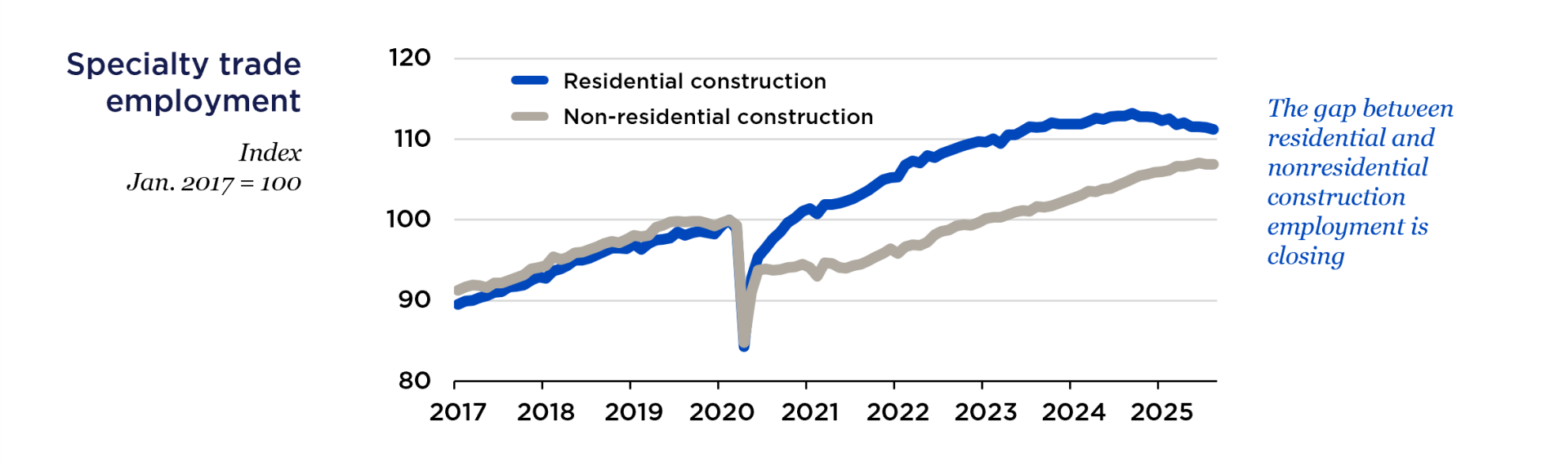
Specialty trade contractors faced rising labor and material costs (copper, steel, plastics) in 2025, driven by worker shortages – especially among electricians – and tariff-related inflation. Residential demand weakened due to elevated mortgage rates, but nonresidential employment continued to grow, narrowing the gap between segments. Looking ahead, stabilizing input prices and federal tax incentives may ease constraints and support a recovery in demand if construction activity picks up in 2026.
Nationwide’s Construction Practice Leader, Tonya Hahn:
As construction businesses close out a year marked by elevated costs, labor shortages, and policy uncertainty, our Economics team’s report signals cautious optimism for 2026. However, persistent risks – from tariff-driven input costs to constrained labor supply and the winding down of infrastructure funding – underscore the critical role of insurance and risk management in helping firms stay resilient. Specialized insurance and risk management advisors are well-positioned to support clients through this transition, offering protection strategies that align with both current challenges and emerging opportunities.